

Instagram Is Stealing Our Content to Sell Knockoffs — and Yours Could Be Next
I can't see it. I can't turn it off. And I don't get paid.

A friend of mine sent me a text this weekend from a friend of hers. The message was casual — she wanted to know how I’d gotten this cool new “Shop the Look” feature on my Instagram page.
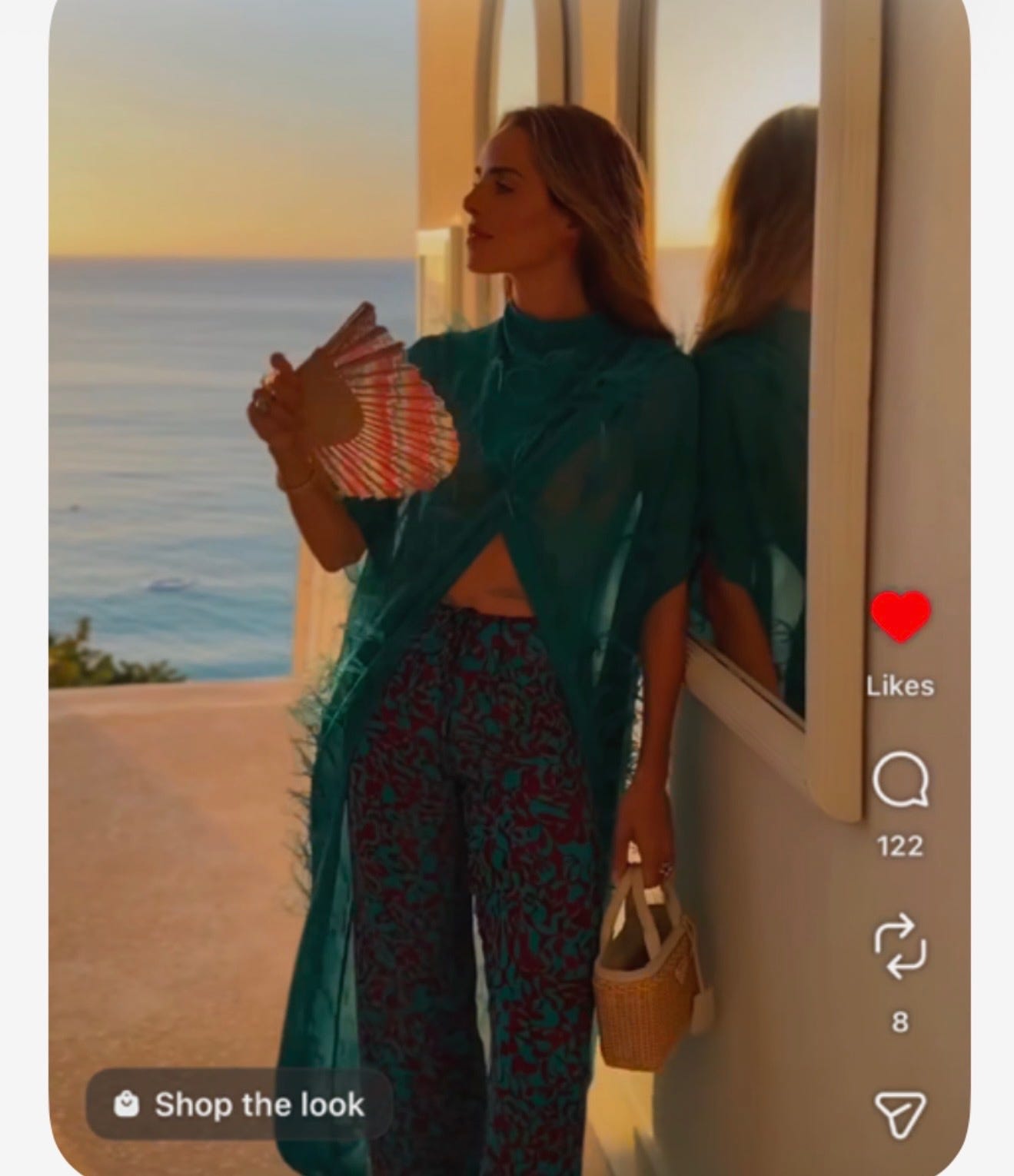
I had no idea what she was talking about.
So I looked. And what I found shocked me. Instagram has been overlaying a “Shop the Look” button on my Reels — without my knowledge, without my permission, and without telling me. When followers tap it, Instagram serves them product suggestions generated by AI. Not my affiliate links. Not brands I chose. Not products I’d recommend.
The outfit consisted of pieces I’d carefully selected from designers I love and personally support. Not a single one of those products appeared in Instagram’s suggestions. Instead, my followers were being shown cheap knockoffs and random items from brands I’ve never heard of, attached to my image, under my name.
And Instagram isn’t compensating me for any of it. They’re using my images to sell products for their own profit.
I asked Thomas to dig into it. He discovered that Instagram has been quietly beta testing this feature for months. I’m only just finding out now — and only because a follower happened to mention it. I can’t even see it on my own content. The feature is hidden from creators. I don’t know which of my posts it appears on. I don’t know what products are being shown. I’m finding out from screenshots sent by confused followers, who were shocked I’d recommend such garbage products.
What Happened When I Spoke Up
As soon as I posted about this on my Instagram Stories yesterday, the floodgates opened.
Within hours — not days, hours — my inbox filled with messages from people who were enraged. Followers who had seen the tool and clicked it thinking those were my recommendations. Other creators discovering it was happening to them too. Morgan Stewart had no idea it was appearing on her content. Her first reaction when I told her: How do I turn it off? To our knowledge. She can’t. None of us can.


Then the scope expanded far beyond creators.
People who represent and work with some of the biggest brands in the world — and I mean billion dollar businesses/brands — reached out to say the same thing was happening on their pages. Their brand’s content was linking out to dupes on competitor websites. Even with dedicated Meta account teams, they didn’t know this was happening until they saw it themselves. They’d already flagged it to their reps.
Brand founders wrote to me — people who put themselves and their products out there every single day, creating original, intricate designs, only to discover that their content is being used to surface knockoffs of their own work. For them, every post they make now becomes a billboard for their copies.
A former Meta employee messaged me directly: “And this is why I quit Meta. They’ve been doing this for years. First it was third party tech companies and now it’s creators. I’m sorry. It’s terrible but they won’t stop.”
Oh — and it’s happening on boosted posts too. Advertisers who are paying Instagram to push their content further are seeing “Shop the Look” appear on their ads, linking out to products they didn’t choose and don’t endorse. You’re paying for distribution and Instagram is using that distribution to sell someone else’s product and taking all the money.
We also learned that Pinterest has been doing something similar for a while. We’re only discovering that now too.
All of this from a single Instagram Story in less than 24 hours. That tells you how many people have been sitting on this frustration without knowing who else it was happening to, or what to do.
It’s Not Just Commerce. It’s My Likeness.
There’s a layer to this that goes beyond the commercial relationship. Instagram isn’t just redirecting shopping intent. They’re using my likeness — my face, my styling, my imagery — to sell random products for their own profit.
I’m sure we all sign away more than we realize when we accept the terms of service on these platforms. But I don’t think I’m the only creator who would look at this and feel like it’s a gross overreach of what we agreed to. My image, styled with pieces I chose, presented as if I’m endorsing products I’ve never seen — that’s not a feature. That’s taking something personal and using it without permission.
I can only begin to speculate how they decided this was a good idea for the future of creators — the same creators they’ve built their business off the back of. Honestly, it almost feels like something an AI decided was a good strategy and just started building on its own, without anyone stopping to ask whether it should exist.
Why This Isn’t Just Another Platform Change
I’ve been on Instagram for long over a decade. I’ve lived through every kind of change — reach drops, format shifts, algorithm updates, features that reshape how content works overnight. That’s the deal. You adapt or you fall behind. I’ve made peace with that.
This is different. Instagram isn’t changing the rules. They’re taking something from creators — the relationship with our audience at the moment they’re ready to act — and inserting themselves into the middle of it.
When one of my followers taps a product on my content, they’re acting on years of trust. They believe I chose those items. They believe my taste is behind the selection. Many of my followers know that I earn a commission from affiliate links, and they go out of their way to use them because they want to support me. That’s not a transaction. That’s a relationship. And Instagram is sneakily redirecting it.
As one follower put it: “I am exactly who would end up buying through Instagram thinking I’m supporting you. I’m so mad.”
That’s the whole problem in one sentence.
What’s Actually Being Taken
Trust. I’ve spent a decade building a relationship with my audience where they know that if I recommend something, I mean it. One bad recommendation from someone you trust stings more than a hundred irrelevant ads — because it feels personal. When Instagram overlays random products on my content, it introduces noise I can’t control, can’t see, and can’t correct.
Revenue. Even if the products being shown were decent alternatives — even if followers knew they were alternatives — Instagram still isn’t sharing any of that revenue with creators. They’re capturing purchase intent that I generated, using content I made, and keeping everything.
Brand integrity. I cherish the brands I feature. I’ve had my own brands. I know how hard it is to build something, how much it takes to put your name on a product and stand behind it. Some of these designers are my friends. When Instagram’s AI attaches knockoffs to my content, it doesn’t just hurt me — it hurts the people whose work I’m trying to celebrate and support.
Here’s an Idea: Work With Us
Here’s what frustrates me most. People follow creators for a reason. They want to shop the actual products we’re recommending. They follow us for us. So instead of using AI to guess what we might be wearing and serve up random alternatives — why not let us link directly to what we’re actually featuring?
Let us drop in our affiliate links. People are already doing this in roundabout ways through tools like Manychat. The demand is there. The infrastructure is there. Why get in the way? Why build a competing system that serves worse products, confuses followers, damages creators, and cuts everyone out — when you could just collaborate with the people who make your platform worth opening?
Who Actually Benefits from the Creator Economy?
The creator economy is expected to be worth over $500 billion in the next few years. That number gets thrown around a lot — usually by the platforms themselves.
But features like “Shop the Look” reveal who’s actually positioned to capture that growth. It’s not the creators putting themselves out there every day, taking the financial risk to build a brand, developing original work, and earning trust one post at a time. It’s the handful of companies big enough to sit between creators and their audiences and redirect the value.
When the platforms talk about the creator economy booming, what they often mean is that their ability to monetize creator content is booming. That’s a very different thing from creators themselves thriving.
Why We Never Stopped Publishing on Our Blog
This is exactly why Thomas and I have never stopped publishing on juliaberolzheimer.com — even when every incentive pointed toward going all-in on Instagram. We’ve always believed that the platform you build on matters. Our blog is ours. It’s a place where the relationship with our reader is direct, where the trust they’ve placed in us is protected, and where no one can insert a knockoff between us and the person on the other side of the screen.
It’s also part of why Thomas and his co-founder are building Coreli — to help creators build their own world online. Not just a link page, but a real home base that brings creators closer to their audience and closer to their revenue streams. A place that’s actually theirs.
I’m not saying everyone needs to leave Instagram. I’m still here. But this experience has made us want to invest even further into what we control — into spaces that put our reader and the honesty and trust they have with us at the center of everything we do. And I don’t think we’re the only ones feeling that way.
What We’re Asking For
Let us link our own products. This is the simplest fix. Instead of AI-generated suggestions, use our affiliate links. We know our audience. We chose these products for a reason. Let us connect our followers directly to what we’re actually wearing. The technology exists. The demand exists. Just let us do it.
Give us an opt-out. If that’s not happening tomorrow, at minimum let creators turn this off. The fact that it launched with no control mechanism — and that we can’t even see it on our own posts — says everything about how “creator first” is actually being practiced.
Share the revenue. If you’re going to use our content to drive shopping no matter what, cut us in. A feature that competes directly with how we make a living — using our own content — without any revenue share is not a partnership.
Control the quality. Don’t attach cheap knockoffs to premium content. The AI has no taste filter. It doesn’t know the difference between a designer piece and a fast-fashion copy. But our audiences do, and they judge us — not Instagram — for the mismatch.
Be transparent. Tell creators this exists. Show us which posts it appears on. Show us what products are being shown. Right now we’re finding out from confused followers. That’s not how you treat partners.
@mosseri — I’d rather work with you than against you on this. But “creator first” has to mean something when money is on the table, not just when it’s convenient for a keynote.
I’ve given over a decade of my creative life to this platform. I’ve adapted to every change, learned every new format, played by every new rule. Millions of other creators have done the same. But there’s a difference between the platform changing and the platform taking. This is taking.
And based on what flooded my inbox in a single day — creators, brands, even people inside Meta — I know I’m not the only one who sees it.
This is horrifying. Truly a new low for Meta (though I can’t say I’m entirely surprised). Yes, it’s a free platform and many of us have benefited from it. But it was creators who built Instagram. You could easily argue that it wouldn’t be what it is today if so many bloggers hadn’t moved their communities there in the early days.
This feels like theft (though I do wonder what we technically signed away when we joined the platform?), not to mention the brand dilution that comes from linking cheap, random products to your photos. It reminds me of when Amazon sellers would steal creators’ images to sell knockoffs. I just wish there were something we could do, some sort of collective action to take. A boycott feels apropos, but I worry it would be just a drop in the bucket. I feel powerless. And I’m reallllllly grateful that we’ve both continued investing in our blogs and leaned so heavily into Substack.
I worry that Instagram is only going to get worse for creators, especially with the rise of AI-generated accounts. My feed is at least 50% people I don’t follow, and a good portion of that seems AI-generated. Sometimes I can’t tell whether a post was created by a human.
I don’t know if you and Thomas have read Careless People by Sarah Wynn-Williams, but it completely changed how I view Meta and Instagram. It’s an excellent (and eye-opening) read — and a great listen on Audible.
Really hoping this post makes an impact. Xx
I don't mean to sound callous here, but how is this surprising in any way? The writing's been on the wall for years, and this is just another way the modern media landscape is rearing its ugly head.
Meta has been playing the same game since its inception. Incentivize creators with the golden carrot and a promise of quick reach and influencer riches, only to chop reach and exploit their users' content with every algo update over time. There's a reason why META is a stock portfolio darling in finance circles - it's cuz they're really good at what they do.
Meta will not permit users to integrate with outside merchants via affiliate links, I am willing to bet big on that. The walled garden they established from the beginning is fundamental to their continued success, and with Instagram being synonymous with social media globally, they are too big to fail. Droves of creators cannot afford to leave the platform, particularly those who have decided to publish most of their content and have abandoned (or never started) their own site, where they can wield full control over content distribution and monetization. Smart on your end to never have abandoned your own blog, like so many others have, especially the OGs in the space.
It's beneficial to remind yourself regularly that you *are* the product when the service is offered for free. You clicked to accept their terms, so they can commence with their fuckery anytime they choose.